
What Is Dry Fog, and How Does It Treat Mold?
What Is Dry Fog?
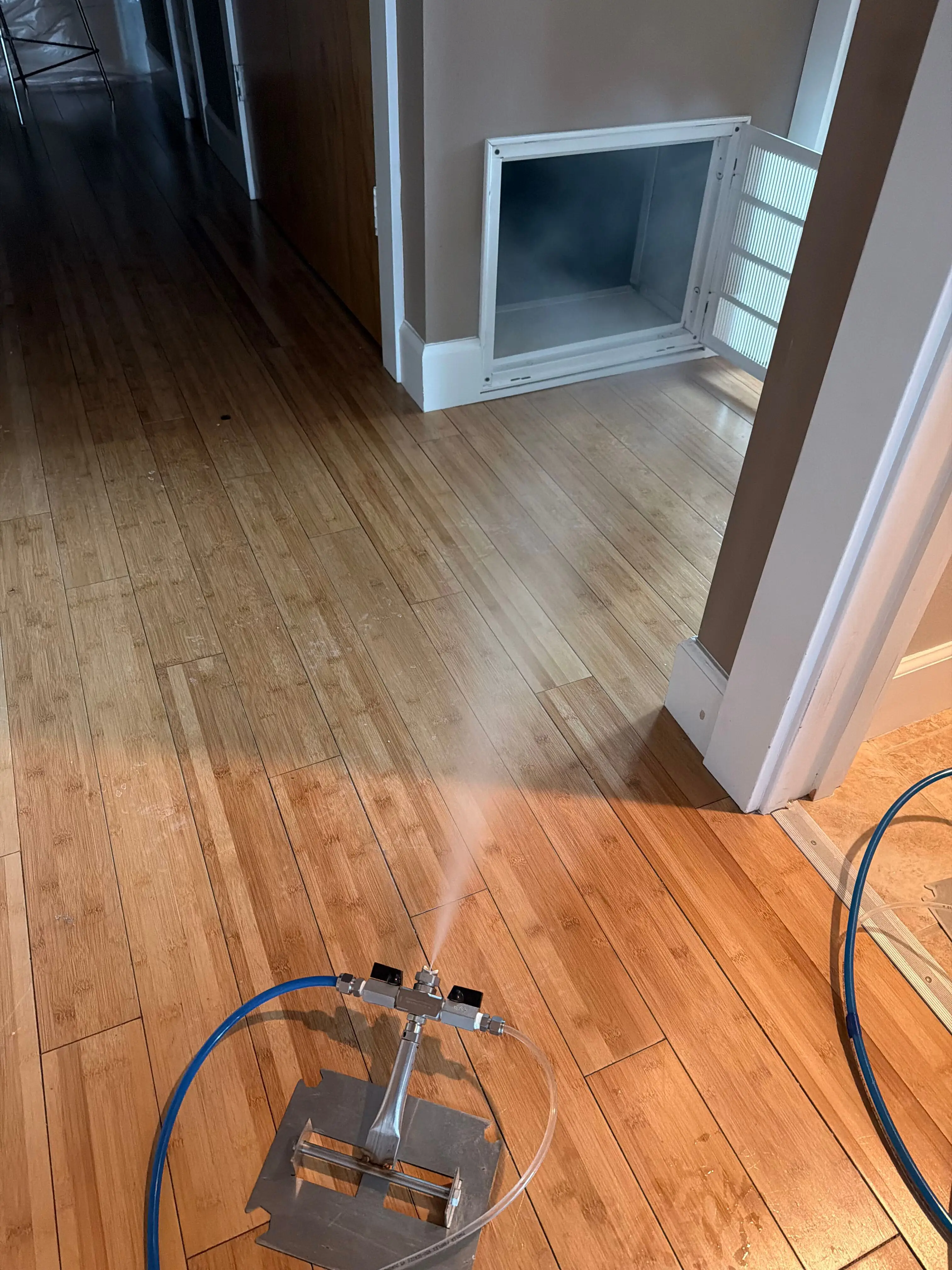
Dry fog is a remediation method that turns liquid cleaning compounds into particles small enough to behave like a gas. The particles measure between 5 and 50 microns across, about the size of a single mold spore. At that size, gravity no longer holds them down. They stay suspended in the air, fill every cubic foot of the space they're released into, and reach surfaces a sprayer or wipe can't physically touch.
That includes the inside of wall cavities, joist bays, HVAC ductwork, attic insulation, crawl space framing, and the air column itself.
The name is literal. Even though it's an aerosolized liquid, the particles are so fine that nothing comes out wet. Surfaces stay dry to the touch the whole time. There's no soaking, no runoff, and no need to cover or remove furniture before treatment. When the fog settles, it evaporates.
The technology was originally developed for hospital-grade environmental disinfection. Pure Maintenance holds the patent on the residential application, and Claro is one of the companies licensed to deliver it across the United States.
The result has been independently tested. A US Army Corps of Engineers performance study found a 95.21% reduction in airborne mold spores in one treated building six months after treatment, and a 99.45% reduction in another. Both results held even after outdoor spore counts rose sharply during the same period. You can read the full study and the rest of the third-party testing on the scientific proof page.
What's actually in the fog
For health-conscious families, the next question is always: what's actually in the fog? You don't want to get into a situation where the treatment is worse than the issue you were trying to treat. We agree, and that's why we publish the breakdown below.
At a high level, the technology we use has:

Claro uses Pure Maintenance's patented dry fog technology to evenly distribute two specialized compounds throughout your home. The ultra-fine particles thoroughly treat both porous and non-porous surfaces, then evaporate and leave all surfaces dry to the touch. The compounds are safe enough that families can sleep in the home the same night.
One important note: the exact formulations are protected trade secrets, so we can't publish everything. But if you want more detail, just reach out or book an inspection and we'll walk you through it.
The two compounds of Dry Fog
InstaPure (SaniDate 5.0)
Instapure is a hydrogen peroxide and peracetic acid solution, EPA registered and OMRI listed. Dispersed as a dry fog fine enough to stay airborne and reach surfaces, cavities, and soft goods rather than wetting them. It oxidizes spores and bacteria on contact, then breaks down into water, oxygen, and trace acetic acid. Breakdown is essentially complete in about 48 hours, which is why our sensitive-occupant protocol has clients stay elsewhere for a short window after treatment. The residual is a faint vinegar note that clears on its own. (see the studies).
EverPure (Goldshield 5)
EverPure is the second compound. It is an organosilane antimicrobial that bonds to the treated surface and inhibits regrowth, so new spores that land later are less able to take hold. It is a quaternary ammonium silane, and we know that is where the questions sit for a building biologist. The distinction that matters: it bonds to the surface rather than sitting free in solution, so it is non-leaching and does not off-gas.
We also make this step optional. For sensitive occupants who would rather not have a persistent antimicrobial in the home, we will complete the remediation without it. We have not seen an issue in the homes we have treated, and we still offer the choice.
Is dry fog mold remediation safe?
The compounds Claro uses are EPA registered, and the first-step treatment (SaniDate 5.0) is also OMRI listed, the Organic Materials Review Institute's designation for products cleared for use in organic settings. For a typical household, the fog is safe enough that families can sleep in the home the same night the treatment is completed. The compounds are non-staining, leave no residue, and break down into water, oxygen, and a trace of acetic acid within about 48 hours.
For households with sensitivities (CIRS, MCAS, asthma, autoimmune conditions, or families with young children or pets), we take a few extra steps: a short move-out window while the first-step treatment fully breaks down, and the option to skip the surface-bonding EverPure step altogether. This care around sensitive occupants is one of the main reasons functional medicine doctors refer patients to Claro. The treatment is designed to clean the environment without introducing new chemical burden.
Where Dry Fog Fits?
Fog does not remove anything. Dead spores, fragments, and the dust they live in come out mechanically or not at all. Any company that fogs a home in place of removing the source and the contaminated material is selling you a shortcut, and the sickest patients are usually the ones who find out it did not hold. Claro treats the fog as a finishing step on a home we have already corrected and physically remediated, in this order:
Optional fine-particle HEPA cleaning is available for full CIRSx protocol. In practice most homes do not need it after the fog, and we will tell you when yours does not.
What the fog does not do
x
It does not remove particulate
Removal is mechanical, and it happens before the fog.
x
It does not replace fixing the water source
Nothing holds if the moisture is still there.
x
It is not a one-application permanent fix
We frame the fog as a proven reduction in spore load, confirmed by testing, not as eradication.
If a remediator is offering fog instead of removal, that is the pattern the mold-illness community rightly calls out, and it is not how we work.
Both compounds are EPA registered. Here are the safety data sheets and registrations, from the manufacturers and the EPA. The SDS describe the concentrate, not the applied fog. Read them and push on anything in them.