
Case Study: Hidden Stachybotrys removed from two nurseries
A family in Peachtree Corners, Georgia called Claro after their daughter's bedroom started to smell musty. With young children in the home, including two nurseries upstairs, they did not want to wait and see. An air quality company had already been out and found high moisture readings inside the wall, which confirmed something was going on that could not be seen from the room itself.
The family had owned the home for about two years, and nothing had been flagged when they bought it. During a full top down mold inspection, our inspector found moisture readings that were highest at the very top of the upstairs walls and spread downward. The attic had been sealed with spray foam insulation, but no ventilation had been added to replace what the foam covered. Humidity from everyday living was rising into the top of the house with nowhere to go, condensing, and soaking into the upper walls of the rooms below.
It is a problem we are seeing more often. Spray foam can be an excellent upgrade, but when it seals an attic without a plan for managing humidity, the moisture ends up inside the walls of the bedrooms where families sleep.
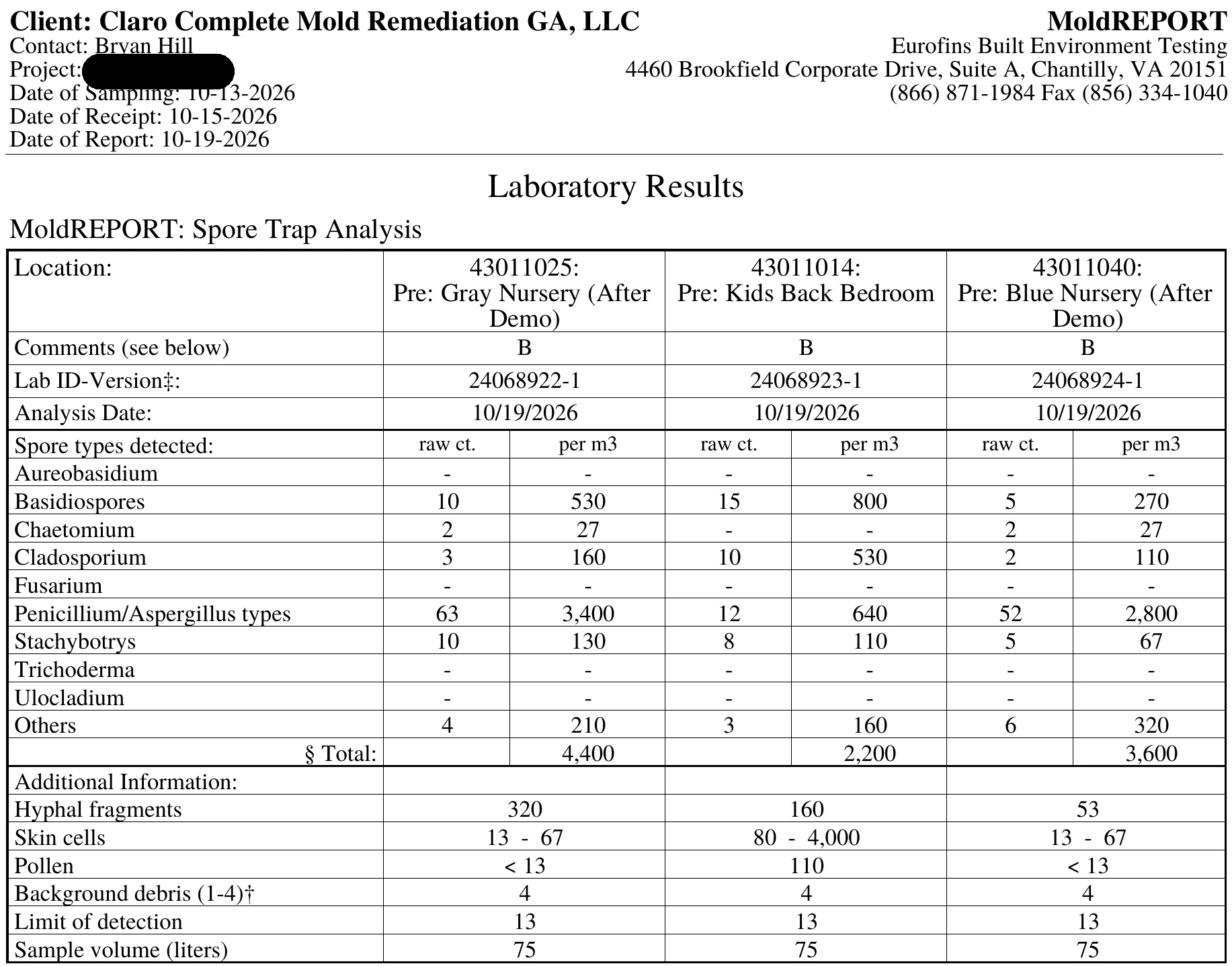
Air samples were collected in six rooms after the damaged walls were opened and before treatment. The counts themselves were moderate, between 2,200 and 4,400 spores/m³ per room, and the lab noted that heavy debris on the samples meant the true counts were likely higher. What mattered most was which molds were present and where.
Stachybotrys was found in five of the six rooms, including both nurseries:
- Gray nursery: 4,400 spores/m³, including 130 Stachybotrys, 27 Chaetomium and 320 hyphal fragments
- Blue nursery: 3,600 spores/m³, including 67 Stachybotrys and 27 Chaetomium
- Kids' back bedroom: 2,200 spores/m³, including 110 Stachybotrys
- Master bedroom: 2,700 spores/m³, including Stachybotrys
- Hex tile bathroom: 2,900 spores/m³, including Stachybotrys
Stachybotrys, often called black mold, and Chaetomium are water damage marker molds. They are rarely found in indoor air unless building materials have been wet for an extended period, so even small counts are significant. Both are known to produce mycotoxins. Finding them in the rooms where the family's youngest children sleep, along with hyphal fragments that indicate active growth, made this a clear priority.
Because the moisture had affected the same wall areas across the upper floor, Claro set up containment room by room:
- Sealed containment around six separate work areas, with air scrubbers running under negative pressure so nothing released during demolition could reach the rest of the home
- Hazardous building materials testing before demolition
- Gray nursery: removal of drywall from floor to ceiling on the window wall, extending 1 to 2 feet onto the side walls
- Blue nursery: removal of drywall from the chair rail to the ceiling on the window wall
- Kids' back bedroom: removal of the top 2 feet of drywall along the window wall and a 1 foot section around both windows
- Master bedroom, master bath and hex tile bathroom: removal of the water damaged drywall along the window walls
- InstaPure Dry Fog treatment across the full 4,046 square foot home, including all HVAC ductwork, to denature mold on surfaces and in the air
- EverPure Dry Fog application to help protect surfaces against future microbial growth
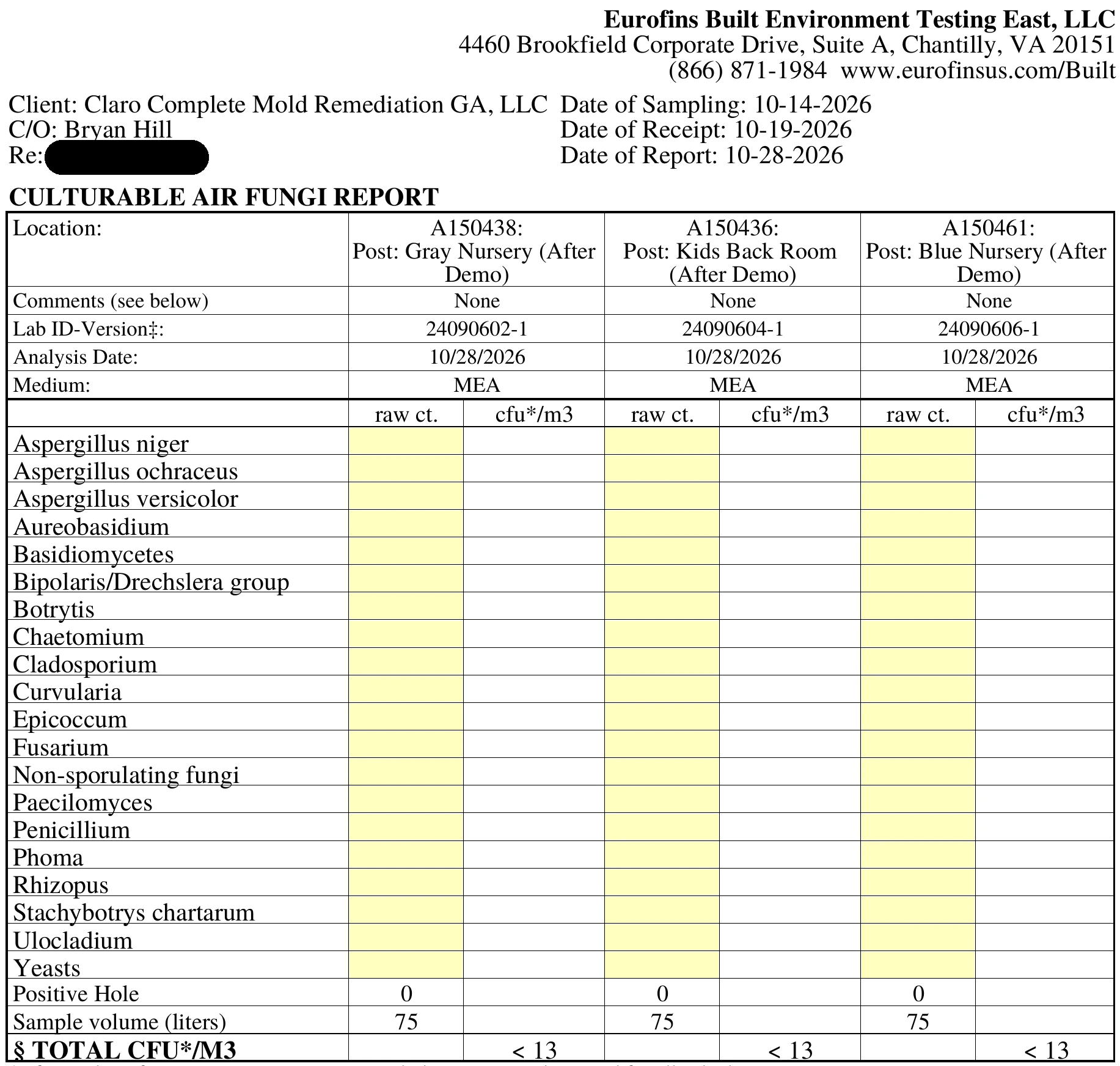
Post remediation culturable air testing, which measures living mold capable of growing, was taken in all six rooms:
- Gray nursery: less than 13 CFU/m³
- Blue nursery: less than 13 CFU/m³
- Kids' back bedroom: less than 13 CFU/m³
- Master bedroom: less than 13 CFU/m³
- Hex tile bathroom: less than 13 CFU/m³
- Master bathroom: 13 CFU/m³, a single colony at the laboratory limit of detection
No Stachybotrys or Chaetomium grew in any sample.
For this family, the result that mattered most was in the nurseries. Two rooms built for their youngest children had been holding black mold behind the walls, and both now test below the laboratory limit of detection, along with the kids' back bedroom. The family now has lab verified results showing the air in every child's room is clean.
A persistent musty smell in a bedroom is worth taking seriously, especially in a child's room. If your attic has been spray foamed, it is also worth confirming that humidity in the home has somewhere to go, so moisture does not end up inside the walls.