
Case Study: Solving the water problem behind a basement's mold
This was not her first encounter with mold, and that was the whole problem. This Creve Coeur homeowner had already had visible mold remediated once in the traditional way. After some later crawl space work, the respiratory symptoms came back every time she went down to her basement, and she recognized the pattern immediately. It was exactly what had happened before.
There is a reason traditional remediation so often disappoints. Mold is airborne. Tear out and rebuild the visible spot and the spores distributed through the rest of the environment are still present, ready to regrow wherever conditions allow. So this time the air itself was tested first, in a home of roughly 1,100 square feet, with baseline samples analyzed by Eurofins Built Environment Testing.
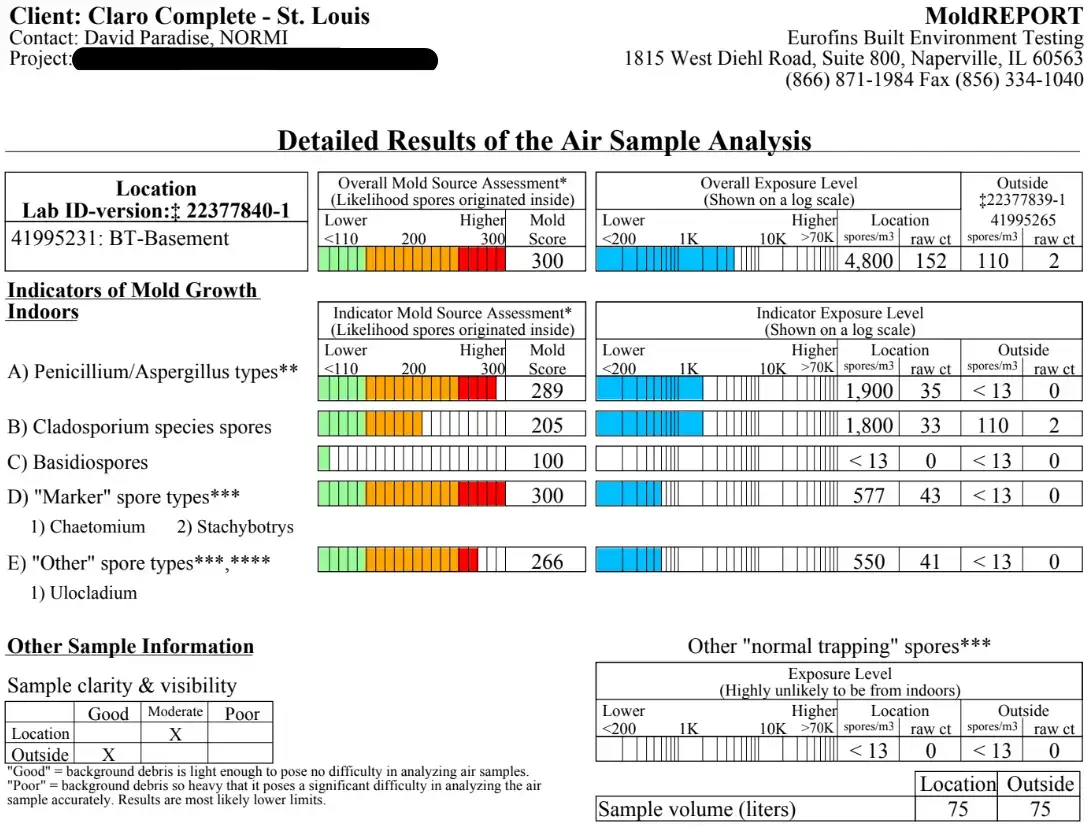
A baseline test told the story plainly. The basement returned a MoldSCORE of 300, the maximum the laboratory reports and firmly in the HIGH range, where a score above 250 indicates a high probability that the spores originated indoors rather than drifting in from outside.
The counts behind that score were stark. Total airborne spores measured 4,800 per cubic meter in the basement against just 110 per cubic meter outdoors, more than forty times the outdoor level. That gap is the signature of an indoor source, not outside air working its way in.
Penicillium and Aspergillus types accounted for 1,900 per cubic meter indoors while none were detected outdoors. Cladosporium measured 1,800 per cubic meter indoors against 110 outside. Marker spores, in this case Chaetomium and Stachybotrys, were present at 577 per cubic meter indoors and were absent from the outdoor sample entirely. These species are uncommon outdoors and generally require sustained wet conditions on cellulose materials such as drywall paper or wood, so finding them indoors points to active growth. The marker indicator scored 300, the maximum.
A sample taken on the main floor scored 183, in the MODERATE range, at 320 spores per cubic meter. The problem was concentrated in the basement, which is exactly where the symptoms were occurring.
Claro's approach is built for this failure mode. Rather than focus only on visible growth, the remediation addresses the whole environment, including the airborne and settled spores throughout the home and the fine dust where they come to rest. Dry fog is one step in that process, and an important one, but the result depends on the full scope of work rather than any single treatment.
Claro also stands behind the work with independent post-treatment testing, and in this case the first check did not come back fully clean. Rather than close the file, Claro returned for a second pass and had the basement retested again.
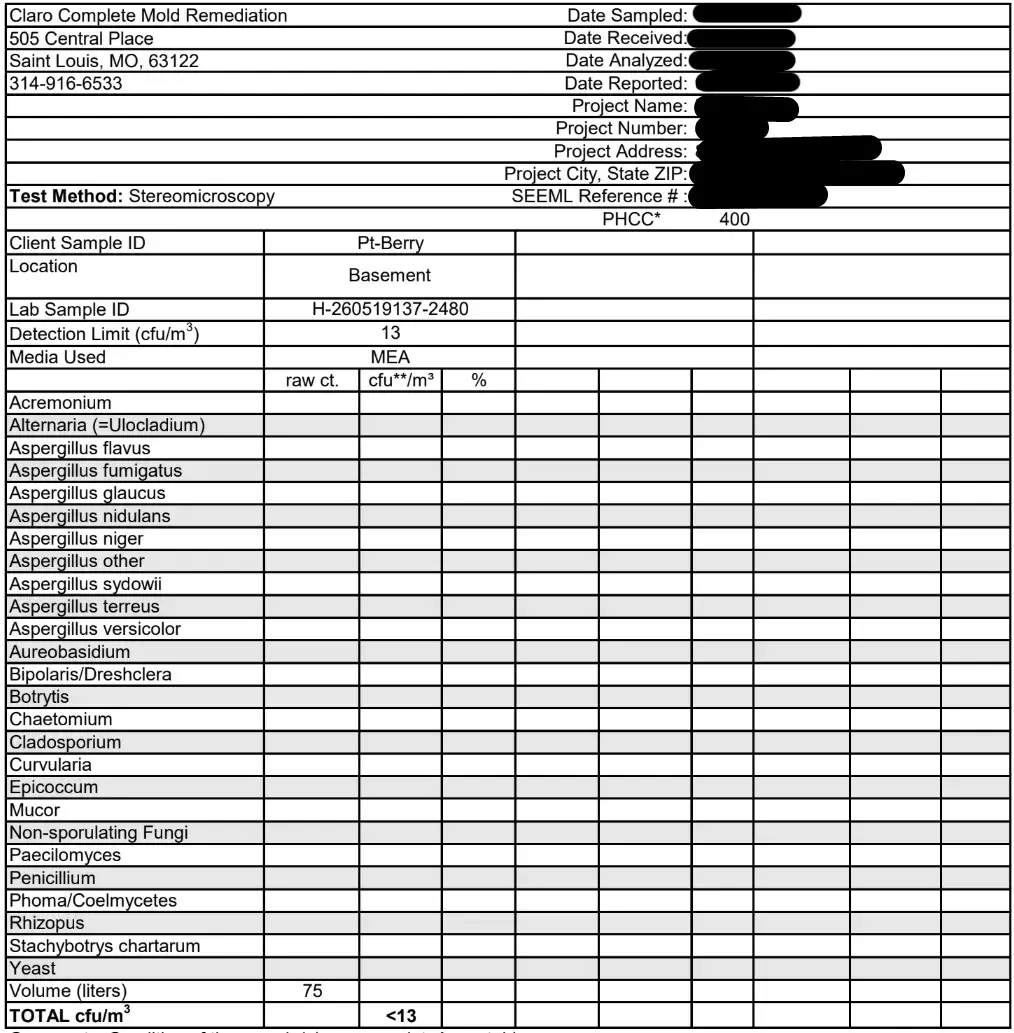
The final clearance sample was analyzed as a viable air fungal test, which cultures any living fungi captured from the air and reports the result in colony forming units. The basement came back at fewer than 13 CFU per cubic meter, the laboratory's detection limit, with no fungal colonies identified.
A trace of everyday mold is normal in any healthy home. What mattered here was that the active growth was gone and, this time, independently verified as gone, backed by Claro's one year guarantee.