
Case Study: Claro cleared a maximum MoldSCORE basement
For most homeowners, a basement that takes on water after heavy rain is an annoyance. For this Oakville homeowner, it was a health concern. A medical sensitivity meant clean indoor air was a genuine priority, and recurring water intrusion kept leaving moisture behind in the lowest level of the home.
Rather than guess at what the moisture had grown, the homeowner had the air tested by an independent laboratory. The baseline sample was collected in the basement and analyzed by Eurofins Built Environment Testing.
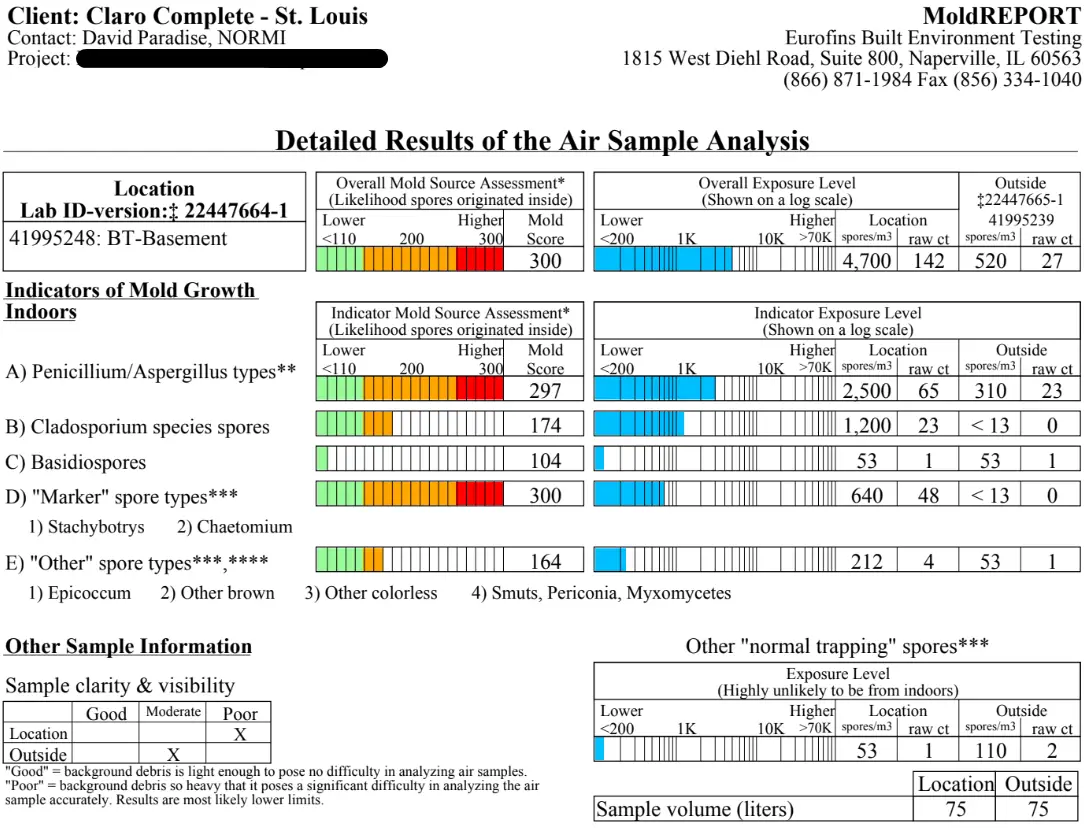
The baseline result came back at the top of the scale. The basement returned a MoldSCORE of 300, the maximum the laboratory reports and well inside the HIGH range. A score above 250 indicates a high probability that the spores present originated indoors rather than drifting in from outside.
The underlying counts supported that reading. Total airborne spores measured 4,700 per cubic meter in the basement against 520 per cubic meter outdoors, roughly nine times the outdoor level. Penicillium and Aspergillus types accounted for 2,500 per cubic meter indoors compared to 310 outside. Cladosporium measured 1,200 per cubic meter indoors and was not detected outdoors.
The most telling finding was in the marker spores. Stachybotrys and Chaetomium were present at 640 per cubic meter indoors and were not detected in the outdoor sample. These species are uncommon outdoors and generally require sustained wet conditions on cellulose materials such as drywall paper or wood. Their presence indoors, even at modest levels, points to active growth rather than outdoor spores carried inside. The marker indicator scored 300, the maximum.
The laboratory also rated sample clarity as poor and noted the trace was overloaded with debris, meaning the reported counts should be treated as minimum values.
Claro treated the home with a whole home remediation, addressing the basement along with the living spaces, the HVAC system, and the fine dust where spores settle. Dry fog is one step in that process, and an important one, but the result depends on the full scope of work rather than any single treatment. Because a lasting result depends on keeping water out, the recurring moisture entering the basement was addressed as part of the plan rather than treated as a separate issue.
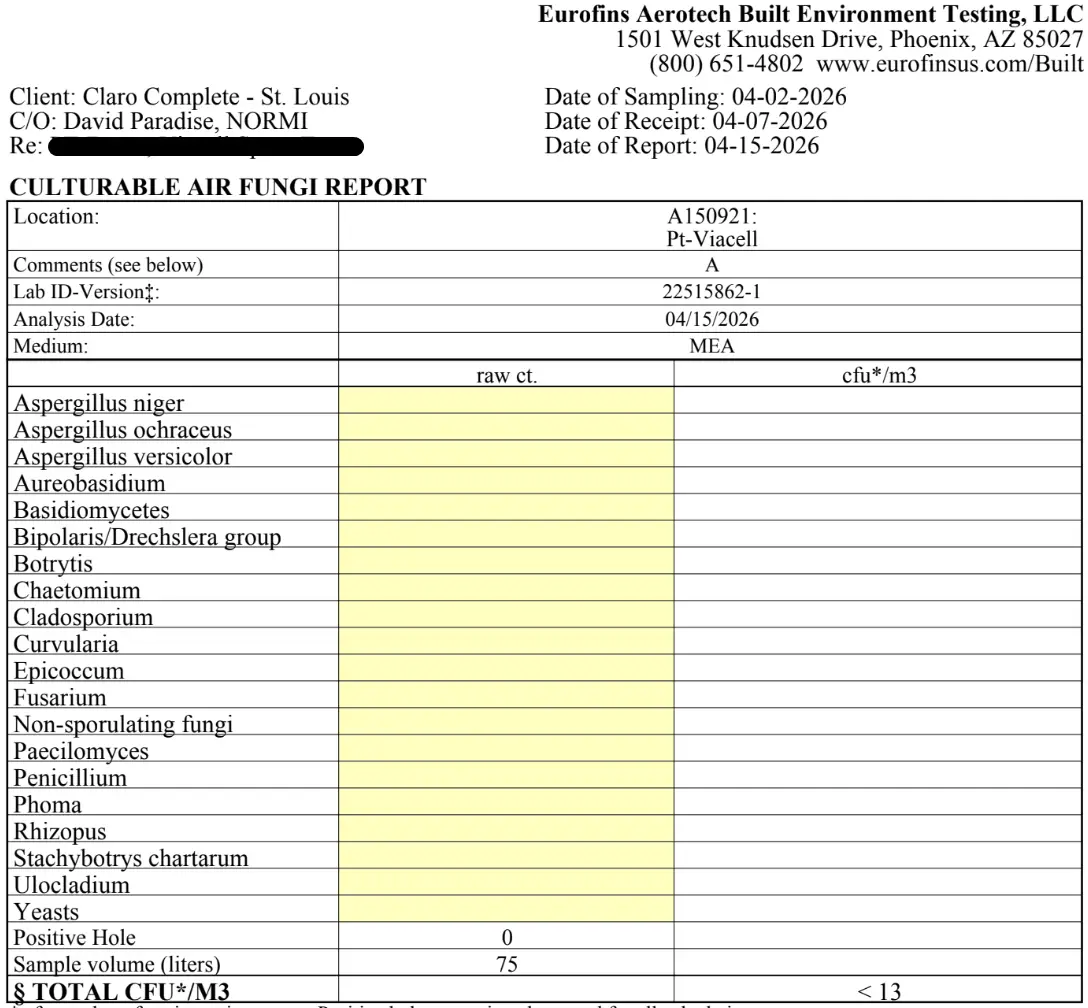
The home was then retested independently. The post-treatment sample was a culturable air fungi analysis, which grows any viable fungi captured from the air and reports the result in colony forming units. The result was fewer than 13 CFU per cubic meter, with the laboratory noting that no fungal colonies were detected at all.
A trace of everyday mold is normal in any healthy home, and the point of the retest was not to prove sterility. It was to confirm that the active growth driving a maximum MoldSCORE was gone. The result was backed by Claro's one year guarantee.