
Case Study: A failed shower tile installation found and fully remediated
A father in Alpharetta called after finding a leak in one of his children's bathroom showers. His concern was not the water he could see. It was the water he could not, and whether it had been getting behind the glass tile long enough to cause hidden damage.
Because the same tile work had been done throughout the home, he wanted all three of his children's bathrooms evaluated rather than just the one where the leak turned up. Claro's lead inspector assessed all three.
The inspection confirmed the homeowner's suspicion and then some. The shower tile in one of the bathrooms had failed because the glass tile had been installed improperly, allowing water to pass behind it and into the assembly. The moisture intrusion was extensive enough that a spot repair was never going to be sufficient. The entire shower stall needed to come out, from the floor pan to the ceiling, including all wall tile, along with the full bathroom floor.
The other two bathrooms showed less extensive moisture damage, limited to the flooring, and required removal of the floor tile only.
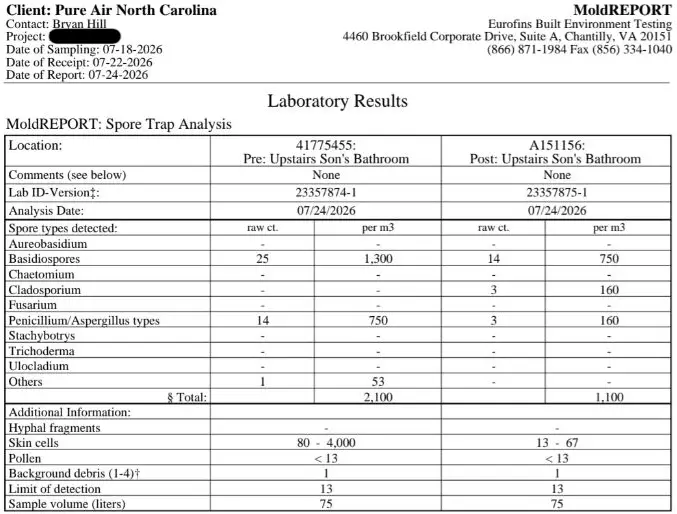
Air sampling in the primary affected bathroom recorded 2,100 total spores per cubic meter, with Penicillium and Aspergillus types at 750 per cubic meter. Airborne readings tell only part of the story in a case like this, since the problem was a wet building assembly behind tile rather than a heavily contaminated air supply. The physical evidence in the wall and floor was what defined the scope.
The remediation matched the extent of the damage rather than the size of the visible stain. In the worst affected bathroom, the shower stall was removed in full, floor pan to ceiling, including all wall tile, along with the entire bathroom floor. In the other two bathrooms, the floor tile was removed where moisture damage was identified and the areas were prepared for restoration.
Because a mold problem returns wherever moisture returns, the work did not stop at removal. A new dehumidifier was installed to control humidity going forward, the HVAC system was serviced to support the treatment, and a warranty retreat was completed in one of the rooms as part of the ongoing service.
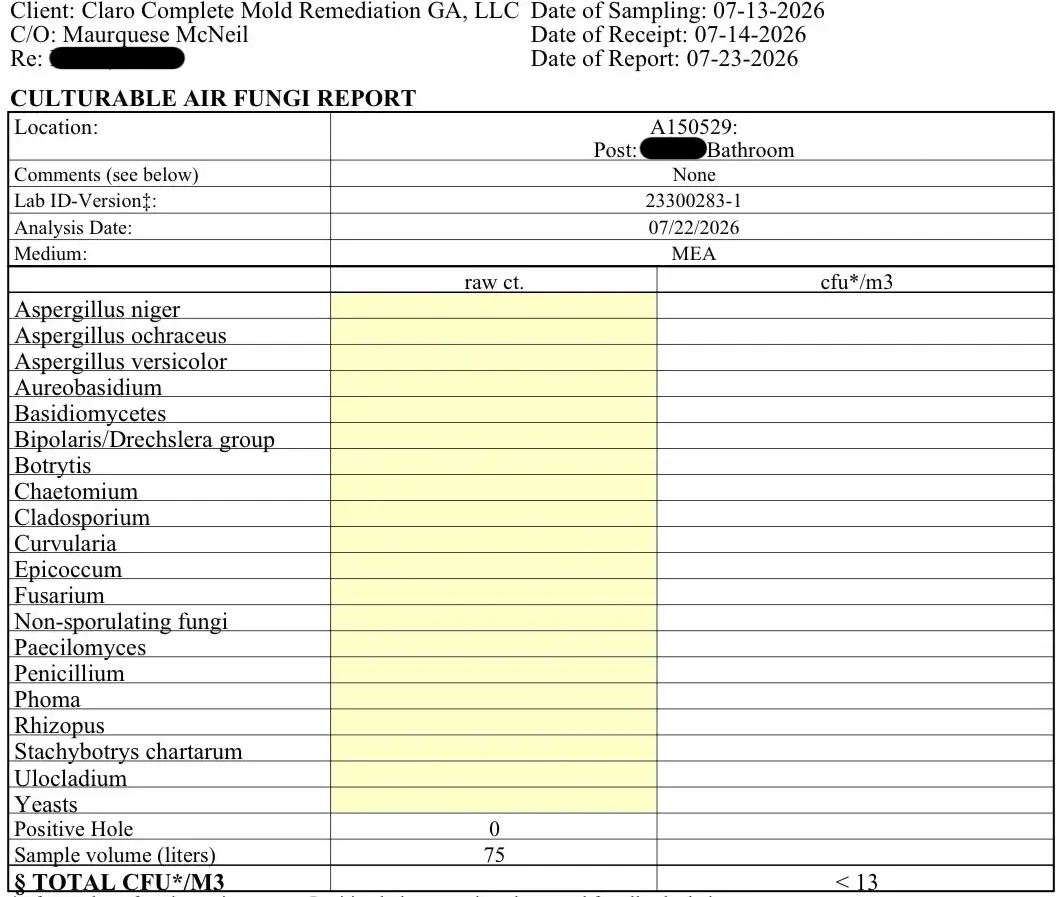
Independent laboratory testing was used to verify the result. Post remediation culturable air samples were collected in the treated bathrooms and analyzed by Eurofins Built Environment Testing. Both came back at fewer than 13 CFU per cubic meter, the laboratory's limit of detection, with no fungal colonies identified.
Spore trap sampling in the primary bathroom showed the same direction of travel. Total airborne spores fell from 2,100 to 1,100 per cubic meter, and Penicillium and Aspergillus types, the group most associated with indoor amplification, dropped from 750 to 160 per cubic meter, a reduction of roughly 79 percent. Airborne particulate in the room fell sharply as well, reflecting how thoroughly the space was cleaned.
A trace of everyday mold is normal in any healthy home. What mattered here was that the failed installation was found, the affected materials were removed, the moisture source was controlled, and the result was confirmed by an independent lab rather than assumed. The work was backed by Claro's one year guarantee.