
What Is a Mycotoxin Urine Test and What Do Your Results Mean?
What Is a Mycotoxin Urine Test?
A mycotoxin urine test analyzes a urine sample for the presence and concentration of chemical compounds produced by certain mold species as byproducts of their metabolism. Not all molds produce them, but the ones commonly found in water-damaged buildings often do — Stachybotrys, Aspergillus, Penicillium, Chaetomium, and Fusarium are among the species capable of producing mycotoxins under the right conditions.
The toxins themselves are not spores. They are much smaller, can be carried on dust particles, and can be inhaled or ingested without you knowing. Once inside the body, some are processed and excreted through urine. That is what the test picks up.
Depending on which panel your doctor orders, it may screen for anywhere from 11 to 31 different toxins. The most accurate tests use liquid chromatography mass spectrometry (LC-MS/MS), which can detect toxins down to one part per billion. Some labs use ELISA, which measures immune antibodies rather than the toxins directly. LC-MS/MS is generally considered more reliable.

What a Positive Result Means
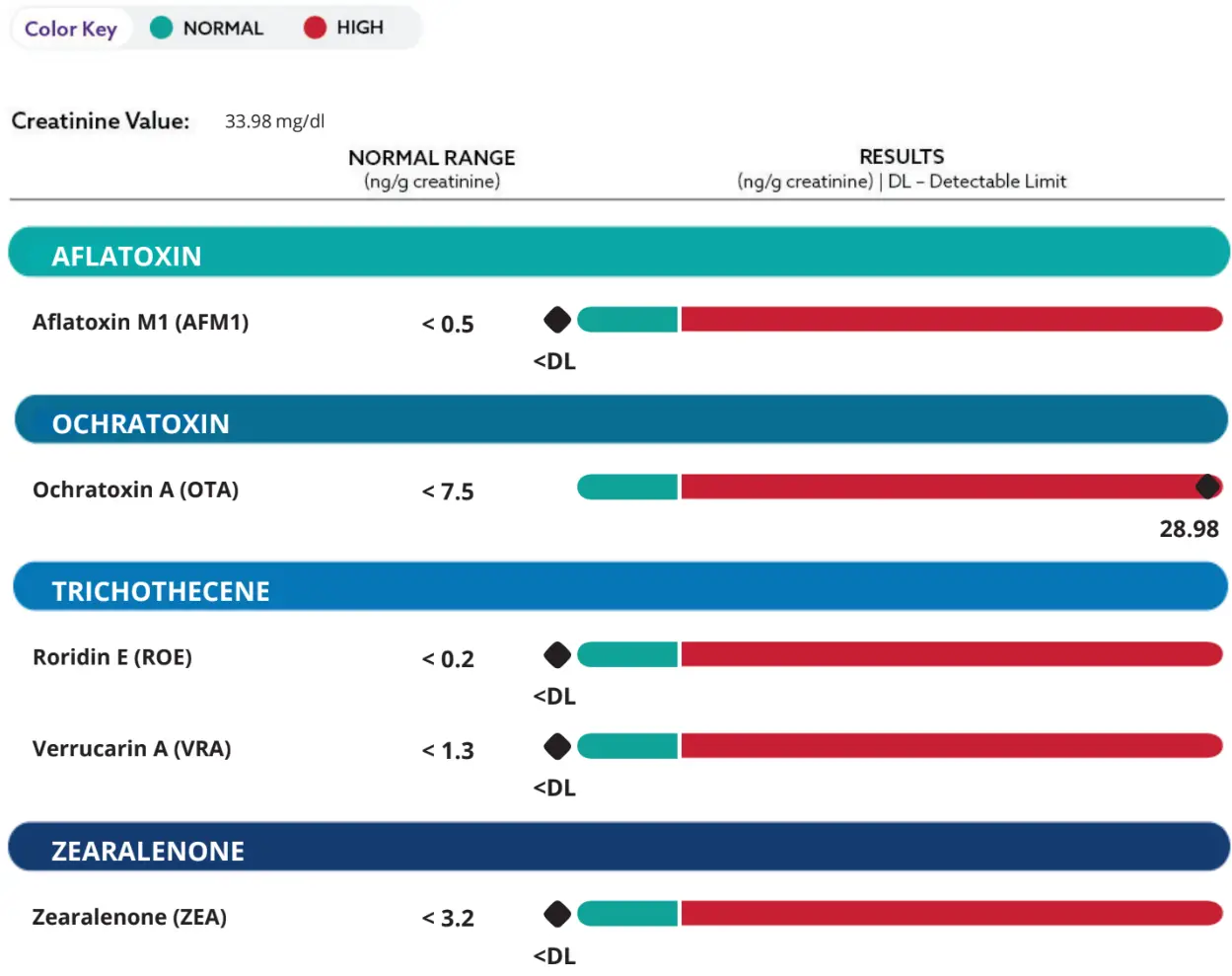
What Each Toxin Is Telling You
Aspergillus, Penicillium
What it means if elevatedThis can be elevated if you are inhaling or ingesting a lot of mold because aspergillus is common on food at and home. Be sure to check your coffee, wine, grain consumption as well as your house if this is elevated
Stachybotrys, Fusarium, Myrothecium
What it means if elevatedNot a significant dietary toxin. Elevated levels strongly suggest a water-damaged building source. Found on board, wood and wallpaper.
Aspergillus fumigatus, Penicillium, Trichoderma
What it means if elevatedNot a dietary toxin at meaningful levels. Presence points to airborne or environmental exposure. Associated with immune suppression.
Aspergillus flavus, A. parasiticus
What it means if elevatedMain source is peanuts, corn, dairy products. An elevated result is less likely to point to a home mold problem than trichothecenes or gliotoxin.
Aspergillus versicolor, Chaetomium, Stachybotrys
What it means if elevatedFound on wallpaper and carpeting in water-damaged buildings. Group 2B carcinogen. Precursor to aflatoxin B1.
Fusarium graminearum, F. culmorum
What it means if elevatedFound in cereal crops and water-damaged buildings. Has endocrine-disrupting properties. Context and other toxin results matter.
What This Test Does and Does Not Tell You
What it tells you
Which mycotoxins your body is currently excreting and at what concentration.
Whether levels are above the lab's reference range for a healthy population.
Which toxin classes are present, which can suggest whether a building or food is the more likely source.
A baseline for tracking whether levels change over time or after moving or remediation.
What it does not tell you
Whether the exposure is coming from your home specifically. Environmental testing is needed to confirm the source.
Whether levels are clinically significant. There are no universally agreed reference ranges across labs.
Which mold species in your home is producing the toxins. That requires a surface or air test.
That your home is the problem. A positive result is a reason to investigate, not an automatic remediation order.
A positive mycotoxin urine test, particularly for trichothecenes or gliotoxin, is a reason to look at your home seriously and schedule a mold inspection and testing. The body test tells you something got in. Environmental testing tells you where it came from.