
How Long Does Mold Take to Grow? Mold Growth Timeline
We get this question a lot, usually right after someone discovers water damage or a slow leak they didn't know about. Mold can start growing within 24 to 48 hours of a surface getting wet, and visible colonies typically appear within 3 to 12 days.
But the timeline isn't just about when mold shows up — it's about what's happening at each stage, because that changes what you're dealing with and what it takes to fix it.
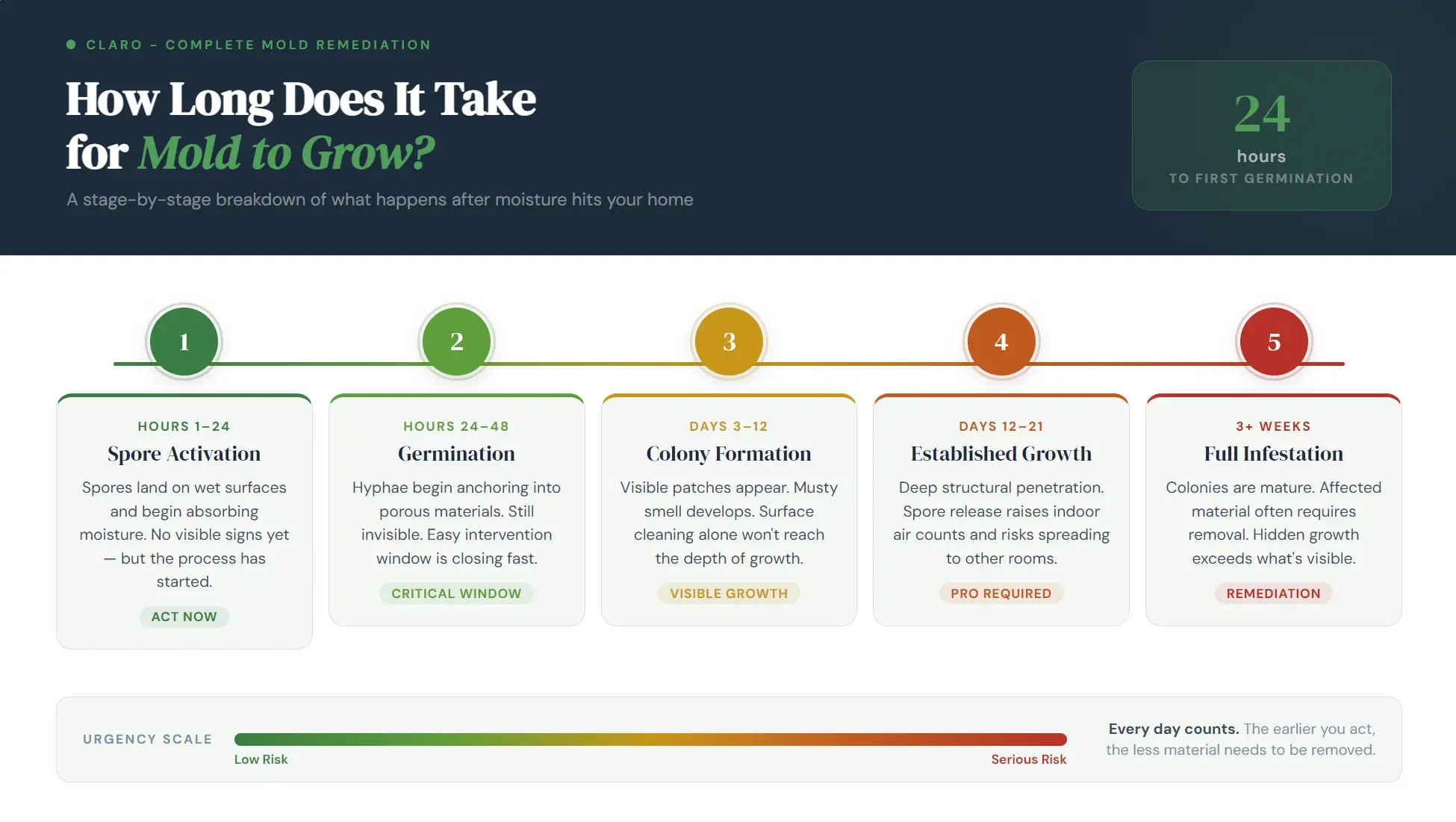
Stage 1: Spore Activation (Hours 1–24)
Mold spores are always present in indoor air. Every home has them — that's just the nature of the environment we live in. Under normal conditions they're harmless, floating around without a surface to colonize. The moment a porous surface gets wet, that changes.
Within the first few hours of moisture exposure, spores that land on wet drywall, wood, insulation, or fabric begin to respond. There's no visible growth yet, no smell. But the biological process has already started — spores are absorbing moisture and preparing to germinate. Dry the surface thoroughly within this window and you interrupt the process before it takes hold.
Stage 2: Germination (Hours 24–48)
By the 24 to 48 hour mark, germination is underway. Spores begin sending out hyphae — thin, root-like filaments that anchor into the surface and start breaking down organic material for nutrients.
You still won't see anything. The surface might look completely normal. But underneath, mold is establishing its foothold. Drywall and wood don't just hold moisture on the surface, they pull it inward — giving those hyphae somewhere to go. If the moisture source isn't resolved by now, you've moved past the easy intervention window.
Stage 3: Colony Formation (Days 3–12)
This is when mold becomes visible. Colonies begin forming as small spots that can be dark green, black, gray, or white depending on the species. What starts as a thumbprint-sized patch can expand noticeably within days. The musty smell typically shows up around this stage too, caused by microbial volatile organic compounds released as mold breaks down organic material.
At this point, surface cleaning alone isn't enough. The hyphae have already penetrated below what you can see.
Stage 4: Established Growth (Days 12–21)
By week two or three, colonies are well-established. The surface growth you can see is now connected to a deeper network of hyphae — on drywall that can mean growth on both sides of the paper facing, on wood framing it can mean structural penetration.
Mold is also producing and releasing spores more actively at this stage, raising the spore count in your indoor air. We've seen cases where a single water damage event led to secondary growth in adjacent rooms because spores spread through the HVAC system before anyone acted.
Stage 5: Full Infestation (3+ Weeks)
Past the three week mark, mold shifts from a localized problem to a much larger one. Affected material is often degraded enough that remediation requires removal rather than treatment. The visible mold is rarely the full picture at this point — what's behind walls and under flooring tends to be more extensive. A professional inspection with moisture meters and air sampling is the only reliable way to understand the actual scope.
Where in Your Home Mold Grows Fastest
Some parts of a home hold moisture persistently, and because they often go unnoticed, problems develop further before anyone finds them.
Crawlspaces sit directly above soil with minimal ventilation, and ground moisture evaporates upward year-round. Without encapsulation, humidity levels can stay above 70% even when the rest of the house feels dry. Mold can establish itself there within days of a wet stretch of weather.
Bathrooms — the real risk isn't the shower walls you can see, it's what's behind them. Grout and caulk failures let moisture into the wall cavity over months or years. The area under flooring around the toilet base is another common site for slow, invisible leaks.
Basements trap moisture behind drywall and under flooring. Any basement that has ever taken on water during heavy rain — even a small amount that seemed to dry up — is a candidate for hidden growth in the wall cavities.
Attics are frequently overlooked. Poor ventilation or improperly installed insulation causes condensation to build up on the underside of the roof deck. Because most homeowners rarely go up there, this kind of growth can go undetected for months.
Around HVAC systems, condensation builds up naturally near air handlers and ductwork. Mold growing near an HVAC system is a particular concern because the system distributes spores throughout the entire home every time it runs. That's why HVAC mold cleaning is one of our most popular services.
The 24–48 Hour Rule After Water Damage
Most restoration professionals use 24 to 48 hours as the critical window after any water event. Get everything dried out within that timeframe and you have a real chance of avoiding mold entirely. Miss it, and you're almost certainly dealing with at least Stage 2 germination, possibly more depending on how wet and warm conditions are.
Speed matters more than thoroughness in that window. Fans running on a still-damp floor on day one does more than a perfect cleanup starting on day three.
The Bottom Line
Mold moves through its stages faster than most people expect, and the gap between "this just happened" and "this is now a serious problem" is measured in days. Early action after any water event is the single biggest factor in whether you're dealing with a minor cleanup or a major remediation.
If you'vehad recent water damage or you're seeing signs of mold growth, book an inspection and we'll assess exactly where things stand. We'vehelped a lot of homeowners who waited — and we'd rather help you before it getsto that point.